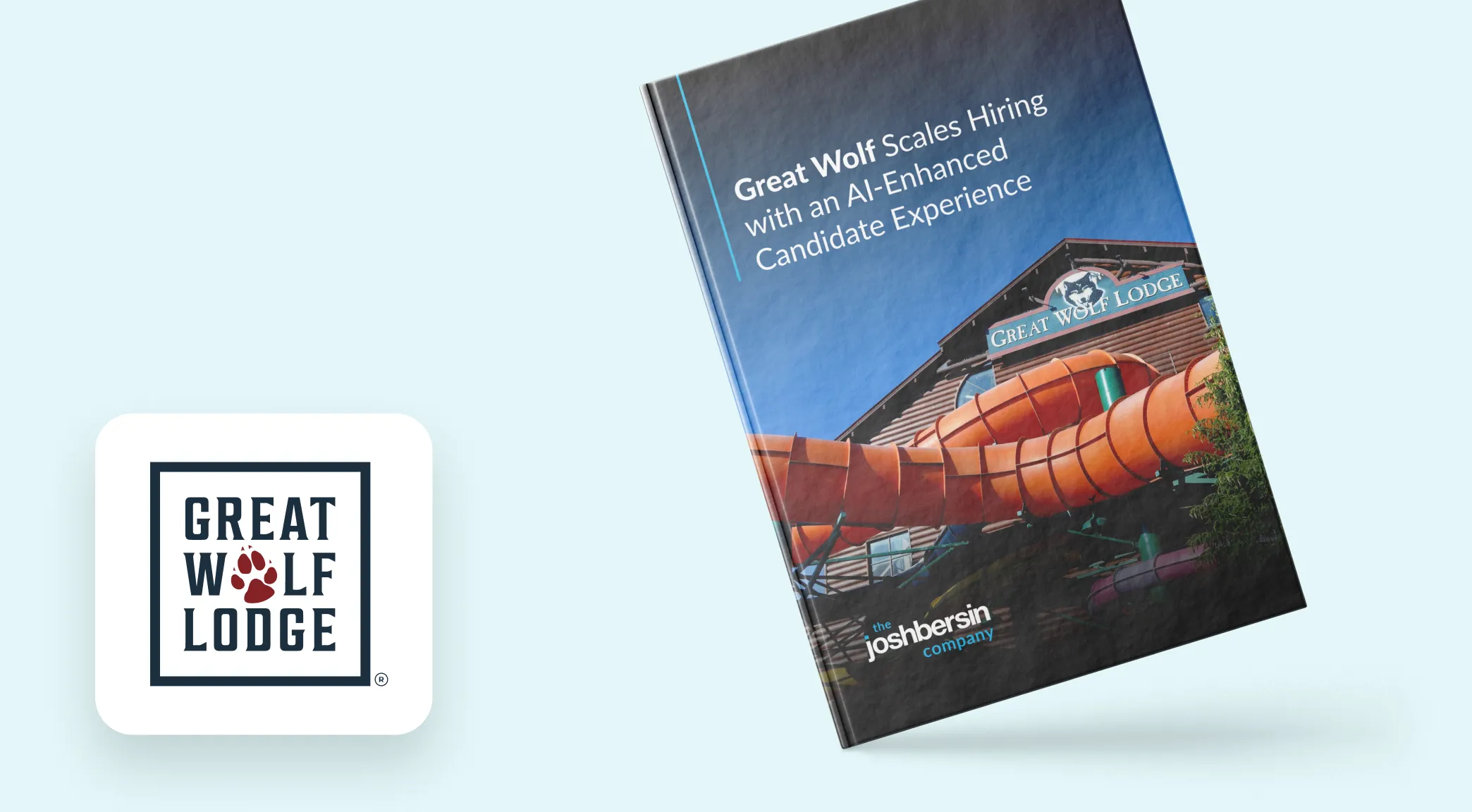
4x applications. $700k in savings: The Great Wolf Lodge playbook.
There's hiring transformations, and then there's this: Great Wolf Lodge leveraging conversational AI to increase applicants, decrease no-shows, and reduce recruitment marketing spend by $700,000 annually.

4x applications. $700k in savings: The Great Wolf Lodge playbook.
There's hiring transformations, and then there's this: Great Wolf Lodge leveraging conversational AI to increase applicants, decrease no-shows, and reduce recruitment marketing spend by $700,000 annually.


This blog is part of a larger collection of client story content for these companies.
Meet the speakers.

Great Wolf Lodge
Great Wolf Lodge

The Josh Bersin Company

The Josh Bersin Company
Watch the on-demand webinar:

Tyler McEvilly (00:05):
Good morning all, or good afternoon in Stella's case or good evening. At this point, we're going to give it a minute or so here just to make sure everyone has a chance to file in. I see that attendee count rising, which is always exciting. Good morning. Good morning, happy Friday, all like I've said for the folks that have joined or just joined, we're going to give it in a minute or so here to make sure everyone has a chance to file in Clarissa. Thanks for the question. The recording will be shared to everyone attending or registered right after the conversation today, and you'll be able to use the same link actually, so the link that we registered with will be converted to an on-demand recording.
(01:24):
Thanks all for joining. We'd love for you to use the chat and engage with us today to make sure it's not just us talking and we're actually answering your questions and feedback. Feel free to start off in the chat with the company you're calling in from your role or anything else that you'd want to share. Really would love to see all of the folks that are joining with us today. We're super excited. We have a great conversation for you with Rachel from Great Wolf Lodge and Stella from the Josh Bersin Company. They've partnered on a wonderful research report and today we'll essentially be going through the results, the story, the background, and everything that we've learned along the way. So with that being said, I'll kick it off to Stella to kind of give us a background on the current landscape of AI in talent acquisition.
Stella Ioannidou (02:19):
Thank you, Tyler. Happy to be here with Rachel and the team. Global Greetings, everyone. I think it's an exciting time to be discussing the seismic forces that are reshaping the entire landscape of talent acquisition right now. We had a lot of work in TA to begin with, but then came artificial intelligence and had us reimagine redesign the entire process and experience both for our candidates but also for our recruiters and our teams and the impact that talent acquisition is having. I think that in what we're picking up from the market, everyone in their uncle appears to be using ai. Even no candidates are using AI to write their resumes, and then companies are using AI to assess them. So there's a lot of that type of disruption going on. But on top of that, I think what we are witnessing is a big shift in the way that hiring, acquiring, onboarding, and even thinking, strategizing about what talent we need into our organization, and we're seeing technology as a key enabler in each and every one of those steps.
(03:43):
We've been doing a lot of deep dives and we've been talking to a lot of organizations about how they are approaching and how they understand this change. A lot of companies are saying that it's not just the TA adoption thing. Of course there is a technology part that's very strong, but it's also a strategic change, like a mindset change and upskilling that needs to take place. A change of how we see the role of the recruiter in the organization. Are we just order takers, go fetch me talent A or talent B, or are we now moving into a more strategic advisor role? And of course, we are seeing a lot of new capabilities and a lot of new simplifications being made available and a lot of organizations leveraging these new technologies made available, but also the rethinking of the role of TA and they're reaping amazing benefits and that's why I'm super excited that we have Rachel with us today. And we're going to be discussing one of the most amazing stories I've ever researched about rethinking what talent acquisition looks like, and not just adopting technology, but kind of redesigning the entire experience and making sure that we are designing something amazing for our team, but also for candidates. So Rachel, would you like to share a few words, introduce yourself and tell us a little bit about you and your role in the organization and how you came up to be at Great Wolf?
Rachel O'Connell (05:26):
Yeah, yeah. Thank you, Stella. My name is Rachel. I am senior vice president of HR for Great Wolf Lodge. I've been with Great Wolf about almost nine years, and in that time have kind of grown from overseeing talent acquisition, talent management, and then the HR function. And prior to Great Wolf, I spent almost five years at the Chicago Cubs baseball team before I worked for Angie's list.com in the technology space. Before that, I worked for a government contractor in the IT space, so a few different industries, but been working for some time now in this entertainment and hospitality area, we have just a lot of frontline hourly individuals that we employ. So imagine if you're going to a resort, you're going to come across front desk agents, housekeeping and hospitality. You're going to come across aquatics where waterpark, food and beverage, all kinds of different positions,
Stella Ioannidou (06:47):
Which is fascinating. Not only the experience and the complexity, but also I love your background because you are able to see so many experiment with different fields, but also experience kind of firsthand the impact that technology can have when you're talking about designing the strategy for talent management and talent acquisition. So what was, let's say, some of the key figures that you can share about Great Wolf and what was the problem the Challenger were solving for? What had you thinking that, Hey, what got us this far is not going to get us into the future. We kind of need to intervene and think differently.
Rachel O'Connell (07:38):
So just for anyone who's not familiar, great Wolf Lodge is a chain of indoor waterpark resorts. We'd kind of describe it like a cruise ship on land. So everything that you really need for your vacation stay is under one roof. And we tend to appeal to families and specifically families that have kids between the ages of two to 12. On average, we are in 23 locations across North America, and in the time I've been with the brand, when I started we had 12 properties. And so the brand has grown quite a bit in my time. We welcome over 10 million guests per year. Most people will drive to a great Wolf Lodge. Typically they're within two to four hours of most major metropolitan areas, and we hire about 14,000 individuals per year. The vast majority of those being frontline, hourly positions, and ultimately for any of you familiar or maybe not familiar, the intent of Great Wolf is to be a family vacation, a time or a place where families can come together, put the digital devices away, and spend a couple quality days having fun with one another.
(09:06):
And so our mission or our purpose, if you visit our website, you'll see it out there. It's to bring joy to families. That's really at the key of every decision that we make, including the hiring process. To bring joy, you have to provide tremendous customer service. And so customer service and guest services at the core of who we are and what we do, and great water slides, great restaurants, retail shopping, none of that really provides joy and great service. It's people. So hiring great people is kind of the first step in being able to fulfill that mission and purpose.
Stella Ioannidou (09:51):
I love that, and I love the growth that you've witnessed from 12 resources to 23 and hiring more than a 40,000 frontline employees every year. Talk about high volume hiring environment, but what were you when you started rethinking let's say, and witnessing that growth and thinking that, okay, we need to support that growth from a talent development and talent management and talent acquisition perspective. What were some of the things that you were solving for at the time?
Rachel O'Connell (10:27):
Yeah. Well, for anyone that works with a predominantly frontline hourly workforce, a lot of these workforces do tend to be high turnover. We are no exception to that. We are often people's first job, particularly because of the waterpark element. We are probably one of the number one employers of lifeguards out there, and it's just a great job for someone who's in high school or college, but part of that means that you're going to be turning individuals over. So that's something that we've navigated and continue to navigate just as part of who we attract to work at Great Wolf that can lead to being understaffed. We are not a, I wouldn't call a seasonal where we are, maybe an amusement park that's only open when the weather's great because we're indoor. We are open year round, but we're definitely busier when kids are out of school.
(11:35):
That's just the nature of our business. When things get busier, it's important to be well staffed. And when you have this workforce that's generally very young, high turnover, it can lead to being understaffed. And that is directly in contrast to what we're trying to accomplish with bringing joy to families in great service. If you don't have enough people to deliver that service, all of a sudden you are closing rides, you are closing food outlets, you're closing things, and that's not the experience that someone wants when they show up. We also, we're a medium to large company, I suppose, but we don't have infinite resources, which I'm confident most HR people can relate to. And so most of our lodges have three, maybe four HR individuals on site, which they have to do talent acquisition, but also every other part of hr. It's important that we're making most of the time that they have within a day. And then of course, COVID-19, the pandemic hit our industry particularly hard along with cruises and other entertainment. And when we were ready to open back up, it was hard to attract people back to the industry. People were fearful. Some people just decided maybe this isn't for me. And so it was particularly hard to get people to come back to work as things were opening up.
Stella Ioannidou (13:19):
I hear you. And in a frontline led, let's say, business model, these pain points are not just statistics that we monitor like KPIs. They're actually directly impacting the experience of the guests, the way that the business operates, the bottom line, because if you're closing rights, you can't just sit on these types of pain points in this type of industry. So what did that look like when you were reaping those, let's say when you were witnessing those pain points, what did the experience look like and what urged you, when did you decide that, Hey, we need to make a change about this. We need to do something different.
Rachel O'Connell (14:10):
In hospitality, your reputation is everything. And if you think about it makes sense. If you hear a bad story about an experience someone had, whether it's a restaurant, a hotel, a resort, a entertainment, that's coloring other people's decision on whether they're going to spend their time and money there. And so if you're closing rides, if you're understaffed, if you're not able to handle the volume, not only is that going to spread by word of mouth, but now we've got TripAdvisor and all these other places where people can share and spread their experience. And so that guest experience, and we measure that through NPS, that is a really important metric for us because NPS so goes NPS as does then ultimately revenue and profit. It's a leading indicator for us in the way that we're going to make strategic decisions and investments in the business. So if there's a poor customer experience that's going to drive a lower net promoter score, and then ultimately we're going to see the ripple effects of that. So we're very, very sensitive to guest experience.
Stella Ioannidou (15:29):
I hear you. So what did you do about it and when did you start? And I mean, I know of course, apparently I know the story, but it's never a du moment to revisit. When did you start with this big change?
Rachel O'Connell (15:43):
Yeah, I mean, part of what's leading to being understaffed or was leading to being understaffed was just the process of contacting candidates. We were really feeling this in 2016 and then early 2017, and we were just, candidly, we had okay, applicant flow, but we weren't able to get ahold of these people. We would call them, we would leave a voicemail, they wouldn't return the voicemail, and it was just a really challenging thing to get even someone to talk to us. And so I remember distinctly, we were opening our Minnesota property in 2017, and I was with the team there and we're just so frustrated. We were getting really worried, almost panicked if you will, because we just did not have enough people coming in the door to staff this property up to open it as effectively as we wanted to open it. And so almost by happenstance, I just used my cell phone and I started texting the candidates.
(16:52):
It was probably breaking all kinds of laws, like texting people without their consent and all kinds of things, but I just was desperate. So all of a sudden, people are texting me back on my cell phone and I was like, gosh, they're actually responding. This is great. And so it started with us then at that point saying, okay, text messaging, there's something here to this. And so we started by providing cell phones to all of the HR teams and having them texting candidates literally physically on a cell phone that worked, but it wasn't terribly efficient and was a bit hard to navigate. And so we started to look for a solution that would allow us to at better scale text message with candidates because we were seeing success with it just with a very manual process. We went into the market and we were looking for really a text messaging solution.
(17:53):
We talked to a variety of different vendors at the time and just kind of by happenstance, I think found Paradox on the internet and set up a demo and talked to them, and I remembered that they stood out because most solutions at that time at least were simply kind of plugged in the number, and then it texted the candidate, and then you had to go back to the a TS over here. It was still kind of manual, but certainly better than what we were doing. Paradox brought in a level of automation to that process that we hadn't even been looking for. Candidly, we were just looking to text people better, but once we saw there were capabilities around automation, that opened up just a whole new door for us,
Stella Ioannidou (18:40):
Which is one of the things that I find super fascinating about the story is that you were looking to connect with the candidates through the wrong channel. So you were looking for channels like okay, an email or perhaps like a voicemail, but your audience was actually there, your candidates were there, but they were using a different channel, which you wouldn't have known unless you've experimented with it. Okay, broke a little few laws here and there, but overall you kind of had to experiment a little bit, play with it and say, oh my God, they actually are. And I love what you said that you thought of in the beginning. Oh, maybe we need a different communication platform. So maybe it's an SMS platform, a text or a PC to text type of thing. But especially when we're talking about the volumes that you had to undertake, you can't really scale that. And the more we're seeing with ta, you kind of need the TA tech stack and the HR tech stack overall to kind of be interconnected. You can, oh, yeah, let me manually input the SMS here and then, oh, it's coming back, and then I have to manually include it in the a TS or whatnot, which is fascinating. So you said, okay, we need a new approach. Paradox came with some goodies on top of that, what did you leverage? What did you build on the platform?
Rachel O'Connell (20:09):
Yeah, initially we started with scheduling. We started with the screening process and we were using a separate applicant tracking system and plugging into that and kind of using Paradox solely as the communication platform and having our a TS separate. Within two years, we were transitioning into Paradox completely as the applicant tracking system. So that was really interesting too, because at the time, I don't know that they had maybe one or two other companies on paradox as an applicant tracking system. I think they were still building the plane as we were flying it a little bit, which was kind of a fun time to be a part of it. But that allowed us to leverage even more automation throughout the process to free up time for our teams to actually spend more time in the interviews, spend more time onboarding individuals in places where we can impact other things that are important to us, like reducing turnover or improving the employee experience. So for us that being able to shift some of the work and automate it through the system was just a big lever in being able to free up time for higher value add activities.
Stella Ioannidou (21:40):
Yeah, a hundred percent. And it's a different concept. It's a different approach overall. It's not just technology adoption. You kind of see that, oh, I started somewhere, but what if I include this? What if I let go of the traditional, let's say approach? So who is Emma?
Rachel O'Connell (22:00):
Emma is our paradox AI agent. I suppose initially we were using Olivia for a short period of time, but then they let us know we had the ability to customize our ai, and so we actually held a contest amongst our lodges at the time to help us name and create an identity for our ai. Just as kind of a fun internal thing. We ended up selecting Emma because at the time, again, back in 2017, we were starting to at that point really get a lot more applicants who were Gen Z, which now, I mean it's predominantly Gen Z, but that was really becoming and gaining steam for us as a demographic. And Emma at that point in time was the most common female name for Gen Z. So that was the reason that we ultimately selected that name and created a persona around her.
Stella Ioannidou (23:12):
I don't think you only created the persona. There was the graphics, there was a story I think about who Emma is and how they can support candidates.
Rachel O'Connell (23:25):
So if you visit the Great Wolf Lodge website, it's not intended to mislead anyone that Emma's a real person because it will say on there, I'm your virtual recruiting assistant. But the intent was to portray her in a more human-like manner. And that was important to us for a couple reasons. One is that we are a people business. We want people talking to people, which in some ways feels counter to using artificial intelligence, but if they're going to be talking to artificial intelligence, we want them to still feel the warmth that they would feel and talking to a human being. And so portraying Emma in that way was important to us.
Stella Ioannidou (24:20):
A hundred percent. And what could candidates do with Emma?
Rachel O'Connell (24:26):
Gosh, now they can do just about anything. She of course answers questions. She will help them apply to the job. She will show them the job description. They can tell her things that they've done or experiences, and she can recommend jobs to them. She'll help them apply. She'll screen them for the position, she'll schedule them for their interview if they're qualified, and then she'll move them through the process at that point. So if they are offered a position, she'll go back and forth through the offer letter process with them. She will kick off and get their background check running. She will schedule them for orientation. She'll remind them about all of these things along the way as well. And so she's really with them from the point of interest all the way up through their first day of work along with our teams. They're interacting along the way with our onsite teams. We still do primarily in-person interviews onsite, but yeah, Emma is their shepherd through the process.
Stella Ioannidou (25:33):
We hear from other organizations that it, in some cases, some candidates, especially when they are offered a job and they accept, they actually want to in some cases meet and thank the virtual assistant who of course many do not understand that it's a virtual assistant. Was that also a case for grateful people wanted to tell Emma I said, hi, thank you for supporting me and all my let's say up until the onboarding phase, do you also experience that?
Rachel O'Connell (26:06):
Oh yeah. People come in all the time and they're like, I'm here to see Emma. We even have one HR team member who looks a lot like the persona that we've given to Emma, and so when she's in the lodges and working, she's often mistaken for Emma.
Stella Ioannidou (26:26):
I love that. How did the recruiting team kind of react and what did they think? Did you need to get buy-in from the recruiting team? Were they open to the change? How did that conversation take place?
Rachel O'Connell (26:47):
Our HR teams were pretty open to the change. They had been experiencing these challenges of getting hold of candidates, of leaving voicemails and not getting a return phone call. And so any solution that was going to help them in that process, they were very welcoming of. I do think there was a bit of buy-in required with our hiring managers across the brand in hospitality, you've got a lot of lifelong individuals who've been in this industry for some time, and the idea that someone's not going to potentially speak to a frontline hourly candidate until they get to their onsite interview was a little mind blowing. And so there was definitely some resistance initially to that from hiring managers but not so much hr. We overcame that pretty quickly, I think. And I really thank some of our general managers of our resorts. We had a couple who just really leaned into it and when they really leaned into it and kind of said to all the leaders, you're going to use this process, you're going to give it a shot. And their productivity and their ability to get candidates in and get staffed, magnified very, very quickly, which then had our other resorts going, how did you get staffed like that? Your numbers are looking really good. How did you do that? And so that really helped us to have a few champions up front that helped. And I would say certainly within probably 18 months, we were kind of past any of that initial pushback that we may have received.
Stella Ioannidou (28:33):
And talking about numbers, what KPIs or what success metrics can you share about the results that you've experienced?
Rachel O'Connell (28:42):
Yeah, one of them that to me is still kind of staggering. I think our initial time to hire from the point that someone's application is received to their very first day of work was averaging over a month. It was like 33 days, which we were feeling pretty good about at the time as I recall. And I looked at it, I'm like, okay, by the time we get the phone call back and we set up the interview and they come in for the interview and then they do all the background check, all this stuff's pretty good. We got it down to about nine days within the first 30 days of implementing the system, which I think was just a massive competitive edge for us because at the time, we were one of the first to do this. And so being able to get candidates quickly was just a massive competitive advantage for us.
(29:47):
We were also able to save our HR teams quite a bit of time. And so when you look at where we were in the points at which an HR individual was stepping into or helping or driving a part of the process now really from the point of interview up to the point of hire, they're meeting the hiring manager wants and they're meeting HR wants, and the rest of it is completely automated within the process. And we feel pretty good about that. We've monitored it very, very closely because there I suppose was a fear that people would just not feel connected to us or to the brand or that we would lose some culture perhaps along the way and candidate experience. So we've monitored that through surveys and we've monitored that through performance and we've not seen a decline in those, so we're grateful for that.
(30:52):
We also saw just some dollar ink savings. So because it took us so long and because people weren't picking up the phone, we were spending millions of dollars on recruitment, marketing, social media, pay per click, all the stuff. And so once we were able to make the process a whole lot easier to apply, we were getting more candidates and so we were able to make substantial significant reductions in what we were spending from a recruitment marketing standpoint. So I think it's on the slide, the $700,000 that's primarily coming from recruitment marketing, which has been driven by the volume. As I reflect back on our prior application process, it required a login, then you had to go through the application and input, even though you uploaded your resume, you still had to input your employer and your title and how long you've worked there and all that stuff. And so the application process went from a, I don't know, 10, 12 minute process down to two to three minutes, much, much simpler. And so that enabled us to really drive that volume higher,
Stella Ioannidou (32:13):
Which is overall fascinating. What I love about how you designed it is you actually kept the moments that matter when you had to meet with a human being in the flesh, you actually kept that part of the experience, but you made sure to automate all of the other demand, the parts of the hiring process that we're taking a lot of not only dollar investment, but a lot of time your team. So walk us through the hiring process a little bit, how it looks like. I love this chart and how it shows you're taking out all the work that's been automated and you actually have what, two key moments and then welcome on your first day.
Rachel O'Connell (33:01):
And so if you look at this chart, really the first three are paths into the funnel so people can come to our career site and search. The referrals can. I mean that's referring to not just referrals that we receive from our internal individuals, but referrals from the recruitment marketing that we're doing. So job boards, social media, all of those things, referring them into the funnel. And then we've leveraged talent communities as well, which has really helped us to build our own database, if you will, of individuals who we know have expressed interest in the past. And so this is a warm lead, if you will, that we can continue to reengage because we also have so many young individuals. Talent communities is great for us because a lot of times they want to come back on their spring break and work for us for just a couple weeks or they want to come back on their summer break.
(34:00):
And so that's really helped us to cultivate that community as well. But then really through the process at that point, they're getting screened if they are qualified at that point, they're getting scheduled for an interview. They do come in for an in-person interview. We don't do virtual interviews in our lodges. We still want to meet the individual in person, really kind of tangibly meet and kind of get a sense for who they are and what they think about service and all of those things. And so at that point then they're really completing most of the rest of the process virtually. So we will bring them in for onboarding and we will help them through that process if needed. But if not, they're doing most of that virtually as well too. So they're coming in for the interview maybe once more to onboard if they need help with it. But other than that, they're really showing up for day one of orientation and people really actually enjoy that. You would think that, oh gosh, I've only met two people from this company. Do I feel okay about joining it? But what our survey show us is they do they really enjoy that speed and the ease of the process for them that it can fit in with the rest of their day in life.
Stella Ioannidou (35:23):
I loving in your story how you're always incorporating feedback, how you're always there measuring, listening in asking, not just measuring NPS, but asking the candidates about their experience, getting feedback from a variety of user groups, getting feedback from communities and then putting it back into the hiring process and redesigning everything which speaks volume of the type of culture that you're building. It's a culture that's made for a great experience and you can't have a great experience unless you're always listening and incorporating that into the solution. Another reason why I am super excited to visit a lodge because we don't have those in Greece, and that's a great segue for you pitch to someone to actually bring something like that in Greece where I reside. But on top of that, and we have some amazing questions in the chat that we will be touching upon surely in a few minutes, but I love where you started. I love how you said that you kind of experimented and you saw what happened. So what could be next? What's in your agenda now that you've redesigned and you completely rethought the entire experience? What could be next? Because a lot of people may say, we got there. It's okay. There's nothing else now to do Zoom, but what could be next for you?
Rachel O'Connell (36:56):
I think you mentioned kind of the listening piece and experience. Again, I'm emphasizing it because it's important on the guest side, but it's really important on the employee side as well. And so that continuous feedback cycle is really important to us to make sure that we're understanding what the experiences that people are having and making sure that we're reacting appropriately because people's perception is reality. And so how they perceive the process is important and feedback is a gift in that sense that generally people will tell you exactly what you need to know. I think that as we look at the talent acquisition process specifically, we've explored ideas and I'm talking more so about our salary positions and maybe even corporate positions about better leveraging assessments to assess candidates. Now that we're in this very AI world, it feels, it used to be when we first implemented this that we kind of had the advantage. We had AI and it was helping us, but now the candidates have it too. And so they're kind of almost like spamming you with just tons and tons of resumes. And so being able to better identify the quality candidates within the volume that we have is probably our next focus and really trying to leverage AI in a way that's helping us to assess those and some of those softer skills that we're really looking for.
Stella Ioannidou (38:40):
Rachel, what would you say is your personal opinion or what you feel AI is impacting the world of talent acquisition? How do you believe that AI is actually changing the play, not just, I would even expand it not only on talent acquisition, but on talent development overall. What are you picking up from your industry and from your experience so far? Where are we heading into?
Rachel O'Connell (39:08):
I mean, I can't see the future, I suppose so hard to have a crystal ball, but I think people are getting really creative with what I've seen with ai. And so I've had questions with hiring managers where we're leveraging AI, for example, and some of our training initiatives, and they ask the question, could we take some of the role playing and things that we're using AI for from a training perspective and turn an interview almost into a tryout and more job relevant simulations. I don't know if that's the future maybe, but it's an interesting way to think about it or kind of an interesting concept and takes that realistic job preview idea to a whole new level. I know for example, in the recruitment marketing side, I think that there's going to be a lot of change coming down the pipeline in the next few years, even on the general marketing side, Google and pay-per-click and all of that is quickly becoming obsolete. And it's about how do we show up in the large language models to present ourselves? And I think that talent acquisition's not going to be far behind that. How do we craft job descriptions and copywriting and all of those things to help us in our sourcing and to play the game and beat the large language models to make sure that our jobs are showing up where we need them to show up. So yeah, I don't know what the future holds, but it feels like there's still a lot of change to come
Stella Ioannidou (40:54):
For sure. Before we open it up to questions, I have a final question for you. So following your experience and the entire rethinking and reimagining and redesigning your talent acquisition process and experience, if you would say go back in time and give Rachel five years ago or seven years ago and advice about considering AI adoption of now that you've been through the journey, what would you do differently or what piece of advice would you give yourself if you were, let's say back in 2017?
Rachel O'Connell (41:40):
We sort of tiptoed our way into it, and as I shared, we almost kind of by accident discovered ai. We weren't exactly looking for that solution, and so we kind of tiptoed into it with the candidate care and answering questions to screening, to the interview scheduling. And that's really where it stopped. And so hindsight's 2020 always, but I suppose my advice would be jump in with both feet a little bit faster. We waited a couple years before we really automated the whole process, and now many, many more people are kind of picking up ai. So it feels like it's the competitive advantage that it's provided is becoming a little bit more diluted over time. And so yeah, that would probably be my advice is as things come out, just don't be afraid to try them and secure.
Stella Ioannidou (42:58):
I love that. And you are right, especially when you're designing a great experience, you need to make sure that everyone in that experience also wants to be on board. Tyler, let's go back to seeing what the questions are from the chat.
Tyler McEvilly (43:15):
Absolutely, yeah, we'll shift our focus to the chat. So appreciate everyone. We've gotten some wonderful questions in the q and a and in the actual chat, so we'll use the majority of our remaining time today on that specifically. And if we don't get to your question, we promise we are happy to chat further. If you reach out specifically from the recording email that you may receive or if you want to reach out to us directly, feel free.
Rachel O'Connell (43:45):
And Tyler folks are also welcome to connect with me on LinkedIn and if I can answer questions that way too, I'm happy to.
Tyler McEvilly (43:55):
Perfect. Well, we'll go up to the first question here for Rachel. Which roles are typically the hardest to fill? And I think we're going to look at pre paradox and post paradox. Has that changed since launching Emma?
Rachel O'Connell (44:10):
Yeah, so hardest jobs for us to fill. The hardest job by far is always housekeeping and the room attendant, the housekeeper position, and there's a few reasons for that. It's a hard job just candidly, and our housekeeping job is even harder than the average because if you think about going and staying at a Hilton, a Hyatt, a Marriott, usually you're probably there on business most of the time and you're probably barely touching the closet in the tabletops and you're kind of setting your stuff in a spot and kind of keep to yourself. And then there's not a huge mess when you leave. But at Great Wolf, you've got a family of four in a room, there's wet swimsuits, there's people eating in the room, there's a lot happening. And so it's a hard job at Great Wolf. We've got bunk beds to make instead of just regular beds.
(45:09):
So that's just been a difficult position for us to fill generally, and we have seen improvement. It is still probably our hardest position to fill, but what I will say is there's some specific things that Paradox has helped us with. One is language, because we are able to, and Emma is able to translate into a variety of languages that has been tremendously helpful to us, and she will, they can't ask, but they don't have to. They can start just responding in their own language and she will move to that language. So that's been tremendously helpful for us. I also think that the text messaging capability has really helped, and I don't mean to stereotype in any way, but housekeeping candidates aren't great at checking their email, they just aren't. And so being able to reach them through text message has definitely opened up the communication for us with those candidates. And because it's a quicker, simpler process, they struggle less and they're able to do it all mobile and through a chat interface. And so all of those things have helped some of the technology barriers that we faced with those candidates previously.
Tyler McEvilly (46:29):
Awesome. Thank you for breaking that down. Rachel. We're going to work backwards here. I saw one that just came in from Vanessa, so I assume this question kind of came up when you discussed you had a login previously for your candidates when they were applying. So the question is around, so when you send the application, do candidates still have to create an account?
Rachel O'Connell (46:54):
No, they do not. So no username or password or anything like that. So the way that they're verifying is through multifactor authentication. So if they want to come back and access their information, they're going to be sent a text message with a code that they have to enter to be able to get back in to that, to their application. So they don't have to remember a password to get back in. They just have to be able to receive that multifactor authentication either through text or email.
Tyler McEvilly (47:31):
And I'm sure that login prior was a pain point for candidate drop off if folks forget their password or
Rachel O'Connell (47:38):
Oh my God, yeah, anyone who works with frontline hourly creating that password and then remembering that password is next to impossible, that was a huge barrier for us.
Tyler McEvilly (47:56):
Awesome. We'll move on. Thank you for the question. Vanessa, do you continue to have recruiters? If so, what's their role in the process look like today?
Rachel O'Connell (48:04):
Yeah, so we really only have one central recruiter who works primarily on our salaried exempt positions across the resorts, but recruiting is always set both prior to using this technology and since then with our HR teams. And so we've got an HR team at each resort. Typically the structure looks like an HR director, an HR manager, and then a couple HR coordinators. And they're typically splitting the recruiting responsibilities up amongst the team, but they're also responsible for every other part of hr. So they are not specifically talent acquisition dedicated individuals. They are human resources individuals. So we still have those individuals, but we've redirected a lot of their time toward what we call PAC experience. So our employees are PAC members and they are really focused on engagement and the PAC experience because as you've heard me say, that's really, really important to us and we were not spending enough time there. And so engagement has definitely consumed all of the available time likely that we were able to get out of the software.
Tyler McEvilly (49:23):
That's awesome. I love the name PAC members. Have you noticed any changes in candidate quality or turnover since moving to more of an automated process? So interesting question. Obviously you've seen, we went through the KPIs and really impressive numbers from a recruitment marketing spend reduction time to higher spend reduction, but what does that look like when you're seeing retention?
Rachel O'Connell (49:52):
So we have seen a reduction in turnover since the implementation of the system. Now I say that with a tempered outlook because turnover's still high. We're still a high turnover business, but we have seen meaningful reductions in it in terms of candidate performance or quality of candidate. We haven't measured that in the most scientific way, just to be candid. I do think we get our pick first because our hiring process is faster than most of our competitors. And so I think that we're getting back to the quality candidates faster than our competitors are. And so we're getting our pick in that sense, but we're not measuring it down to performance or we have our kind of service model that we teach and have them embody, and we're not measuring it through that.
Tyler McEvilly (50:55):
Awesome. Are all of your candidates using chat to apply? If not, what's the percentage of chat to apply versus traditional?
Rachel O'Connell (51:06):
All candidates use chat to apply.
Tyler McEvilly (51:08):
Awesome. Easy one. What has been your biggest challenge since implementing this tool?
Rachel O'Connell (51:17):
Gosh, I would say there have been different challenges at different points along the journey. When we were working out of a separate applicant tracking system, the multiple systems was a challenge, most definitely for our teams to manage now still better than where we came from, but a challenge nonetheless, just to be working through multiple systems and we didn't have great ways of integrating the data. So that was kind of an initial challenge. We moved past that when we implemented Paradox as our A TS. I would say today biggest challenge is actually getting hiring managers to open up more of their calendar for scheduling of interviews. That's a pretty constant struggle where they're kind of narrowing the amount of time they're dedicating each week. And so we're having to have constant conversations about here's the labor model, here's the number that you need. You need to be opening up more time on your schedule.
Tyler McEvilly (52:33):
Yeah, that's something that we see across the board. So definitely something I'm sure folks here can relate to. Interesting one that just came in actually. So our candidates interviewed by Human HR recruiting at all prior to the first interview. So I'm sure you can touch on a little bit of the conversation that they have with Emma that validates before their in-person interview.
Rachel O'Connell (53:01):
So for our frontline hourly positions, no, they are just completing the hiring manager interview. That is a change that we made. When we first implemented the early part of the system, we were still conducting an HR screening step, but if we actually broke the numbers down, our team was pushing on to the hiring manager, like 90% of the candidates that they were interviewing. So it wasn't a meaningful screening step in the process. So we took that away. We do still do a HR screening for our salaried exempt positions to identify are they qualified, truly, are we in the right compensation range culturally, do we feel like they align before they're meeting with the hiring manager?
Tyler McEvilly (53:58):
Awesome. A two-parter from Eric Miller. So Eric is wondering how does Emma automate the offer letter in onboarding forms? And then the second part to that was just had to double down on the Go Cubs.
Rachel O'Connell (54:17):
Go Cubs and with the offer letter, so when we're ready to make an offer, a recruiter notes in the system that we're ready to send an offer, we have pre-populated offer letters in the system already. And so all the recruiter really needs to input into Paradox is that their start date and their starting pay rate, but I think just about everything else is pre-populating in there. So they're saying, we need to send an offer, here's the date, here's the pay, and then it's sending that to the candidate when it comes to onboarding. So similar process, once someone has accepted the offer and they've passed that background check, then she is sending them their onboarding paperwork. So this is stuff like their tax paperwork, their handbook that they need to sign off on, policies, procedure, all the stuff that you need to do so that we're not spending time with them when they come in on the first day doing paperwork. That's not fun for anyone. So we get that out of the way. And then that way when they come in, they're sitting down in orientation and they're hearing and interacting with us is the first interaction versus paperwork.
Tyler McEvilly (55:41):
And that background check, we just got a question. How does Emma go about that? So how does Emma communicate that that needs to be accomplished before day one?
Rachel O'Connell (55:51):
Yeah, so after they accept their offer, she's automatically sending them the authorization to fill out to say, Hey, we need to run a background check. We need you to input this information to allow us to do that. So they're listing where they lived and all that stuff. And then we partner with Sterling is our background check provider. And so then she is sending all of this information into Sterling and the background check is running. If the background check comes back with nothing on it, it's sending that data to Paradox and it'll come back as background clear if anything pops up like even a speeding ticket or worse, it's going to flag it to say someone needs to review this. So then our teams will open up Sterling and go pull the full report and review it. So if it's clear, they don't ever have to leave Paradox. They only have to leave Paradox if something comes back on the background check.
Tyler McEvilly (56:53):
Perfect. Well, it looks like a final question just came in. Is there any assessment in place other than the hiring manager interview for most roles? For example, referencing a score or skills-based assessment?
Rachel O'Connell (57:07):
So today we do not. That is something that we've looked at and are considering, especially because now candidates have AI in their pocket as well. And so I think that verifying what you're getting through all this automation that's happening now on both sides of the coin just feels like a next prudent step in this journey for us. But today, no, we do not.
Tyler McEvilly (57:38):
Amazing. Well, thank you all for the awesome questions. I think really helped round out the story. It looks like we had one more come in. Oh, just a reference on an assessment tool. But Rachel, Stella, anything else that we want to close out with, obviously really appreciate you walking through 2017 to 2025. A pretty impactful story.
Rachel O'Connell (58:06):
Yeah, no, just thank you. And yeah, I'm happy to connect with anyone and hope this was helpful.
Stella Ioannidou (58:17):
Well, on my end, thank you for everyone making our conversation run so smoothly with your questions. I'm super excited every time we have this type of discussion, and let's say we have a true story and we can dive into see, not just in theory why, for example, artificial intelligence is something good for a tele acquisition, but exactly how it was implemented, why, when, what's next? So I'm really excited to continue to witness what Great Wolf is doing now that, as Rachel said, candidates have AI in their pockets as well. So what's next? Really exciting times to be in TA right now, I think.
Tyler McEvilly (59:04):
Awesome. Well, I'm sure a lot of folks are headed off to big events in this space next week and throughout the next month. So safe travels to anyone going out there and if you see Paradox or anyone on the call here, feel free to say hi and we can connect further. So thanks all. Have a good rest of your Friday and enjoy your weekend.
Stella Ioannidou (59:28):
Thank you. Thank you.
Meet the speakers.
Great Wolf Lodge
Great Wolf Lodge
The Josh Bersin Company
The Josh Bersin Company