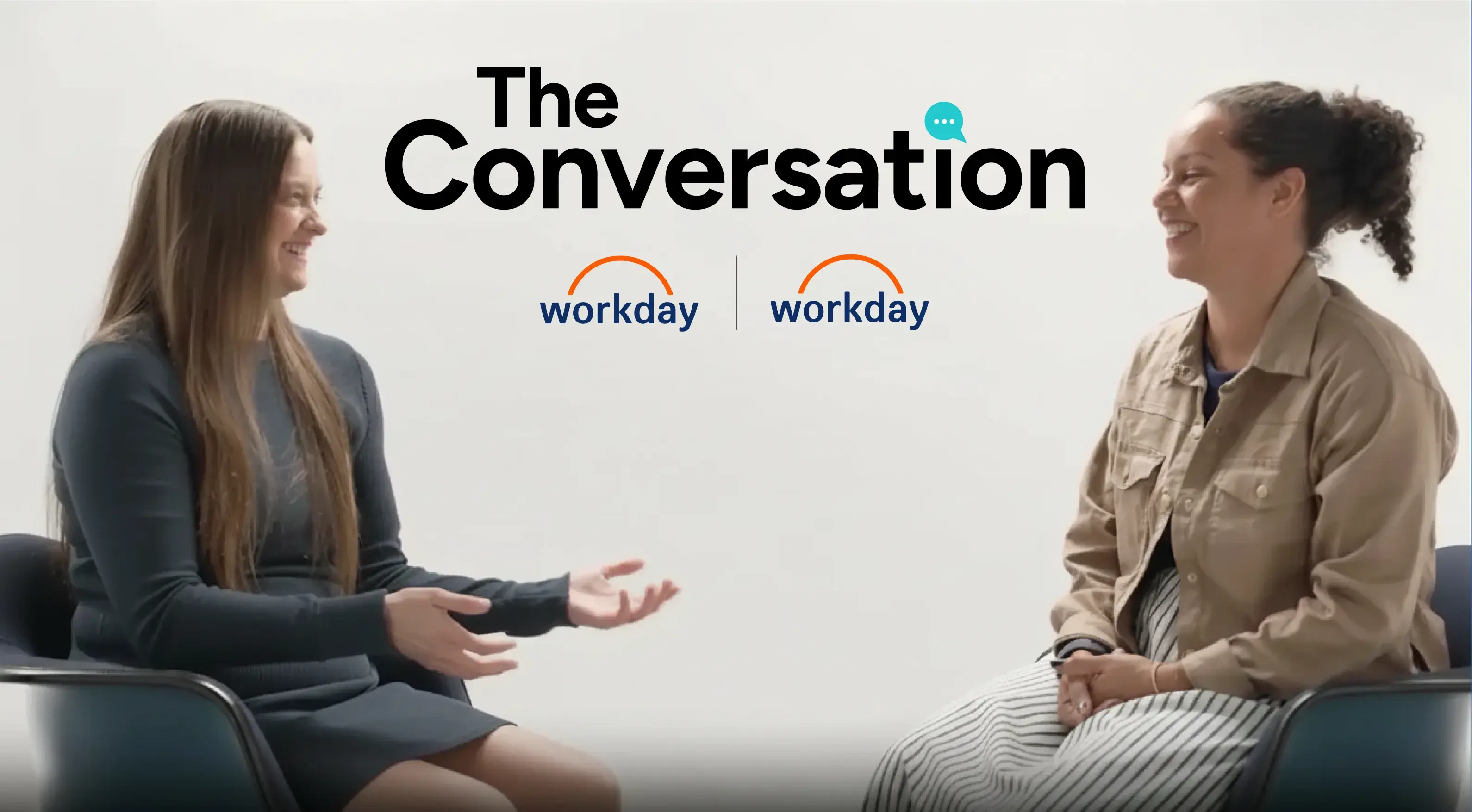
The Conversation with Workday.
Workday Director of TA Technology Experience and Enablement Siena Sarmiento and Principal TA Technology Program Manager Abby LaLiberty went in on HR tech, moving away from temporary point solutions to holistic ecosystems, removing administrative burdens to give recruiters their time back, upskilling them to be strategic talent advisors, and how AI is transforming the future of global talent acquisition.
The Conversation with Workday.
Workday Director of TA Technology Experience and Enablement Siena Sarmiento and Principal TA Technology Program Manager Abby LaLiberty went in on HR tech, moving away from temporary point solutions to holistic ecosystems, removing administrative burdens to give recruiters their time back, upskilling them to be strategic talent advisors, and how AI is transforming the future of global talent acquisition.


This blog is part of a larger collection of client story content for these companies.
Meet the speakers.

Responsible for driving Workday Recruiting systems roadmap forward by integrating new third party tools, implementing WD Recruiting system enhancements and iterating on current offerings.
Responsible for driving Workday Recruiting systems roadmap forward by integrating new third party tools, implementing WD Recruiting system enhancements and iterating on current offerings.
Driving the strategic vision for TA technology at Workday by moving away from point solutions and building a cohesive, AI-powered recruiting ecosystem. Focused on implementing tech enhancements that give recruiters their time back.
Watch the on-demand webinar:

[0:00] Abby LaLiberty: Are we ready? Like... Siena likes to travel and drink champagne... Siena Sarmiento: Long walks on the beach...
[0:11] Abby LaLiberty: So, this is Siena Sarmiento. She is the Senior Director of the TA Technology Experience and Enablement team at Workday.
[0:19] Siena Sarmiento: And this is Abby LaLiberty. She is our tech guru in the TA space. The Tech Program Manager. She takes vague ideas and problems and turns them into reality and system.
[0:34] Abby LaLiberty: In other words, we make magic. Siena Sarmiento: We do call ourselves Team Magic.
[0:40] Abby LaLiberty: Tell me about our journey so far in TA technology with AI expansion and all of that so far at Workday.
[0:50] Siena Sarmiento: Yeah, so previous to now, I've been at Workday about seven years, and we've really tried to avoid the shiny star—the "this is going to solve all of your problems, we're going to boil the ocean, end-to-end hiring process, we've got you, you should implement X, Y, and Z tech that's going to save your recruiters' lives." We've really tried to avoid jumping into that. A lot of it is, we're not trying to add more technology, let's add to the tech stack slide 50 different tech stack items. We've really tried to avoid that and really leaned into the foundation of the Workday recruiting system. That's different now. We're really looking at that "less is more." Less is more across the recruiter activity, and really AI is the living and breathing assistant that helps you do that. So it's less about "add." Abby, I don't know what your take on that is and your experience in the last couple of years here working at Workday, people coming to you, vendors coming to you with new ideas.
[1:54] Abby LaLiberty: Yeah, so working with you and working with our TA directors and leaders, there is a lot of conversation about what can we do to make the system function better for our recruiters. Does that include automation? Does it include people and humans in the loop? What is the best combination of magical items to come together to make our recruiters successful? Additionally, I get to speak to a lot of customers. I spend a lot of time hearing from the customer perspectives, both on the Workday side and the Paradox side, and they do tell me a lot about the same challenges that we have. It's very relatable. We all understand that, again, it's about finding that magical combination of resources that works for your organization.
[2:44] Siena Sarmiento: The promise of automation can bring a feeling of chaos, lack of control. What is your perspective on how we tackle that?
[2:55] Abby LaLiberty: Our recruiters are very vocal. They have no problems telling us where they might not quite trust something, or they're not really sure if it works for them. So there has been a lot of time spent with them to just get them on board, to help them. They participate in our projects, they participate in creating the workflows, the processes. They kind of meet the assistants, if you will, early on, and then they get to influence it. They tell us how they want it to function, and we spend a lot of time doing that. They do tell us if they're concerned, if they're unsure, and we hear that. We take that feedback, we share it where it matters, but we do encourage people to come to us with a place of curiosity. Don't be afraid, be open, be honest, and ready for a massive change, regardless of what the final decision is.
[3:56] Siena Sarmiento: As Abby said, we really do want our recruiters to be collaborators in figuring out where the AI can assist them. And then the other element that we really lean into is developing their skills in other areas. So, less of that value-add administrative work and really looking at what does it mean to advise the business. What skills do they need to really lean in and be that partner, and not just an order taker. And that really is rethinking what "good" looks like as a recruiter. So that's a lot of the journey that we're on as well. We have skills identified that are critical to success in recruiting, but what does that actually look like? What are our true expectations of recruiters? So that it's not just about, "you've gained efficiency because we've automated X, Y, and Z," it's "you've gained capacity to really lean into another space."
[4:44] Abby LaLiberty: So you mentioned the recruiters being able to spend more time with people, being talent advisors, less time doing administrative-leaning tasks. What does that look like in this current climate where we have a little bit of trepidation in adopting the new way of things?
[5:03] Siena Sarmiento: I think we really are at that pressure point with this. There's recruiters that want to take on that new role and really be that consultative advisor, and others that do not. You stay in this business or you don't. And I think you figure out how you want to be a part of the creation of it. That means you are more responsible for providing actionable insights back to the business about what's working, what's not working, what's broken, and you have to be able to take on the fear of being in that role. Otherwise, I would say recruiting of the future is not the place to be.
[5:37] Siena Sarmiento: If you think a little bit more about the skills that are needed and the actions that we really need to see from the recruiter in partnering with their leadership as well as the business, what are some of the important responsibilities or approaches that you see the recruiters needing to take and being able to truly be that advisor?
[5:56] Abby LaLiberty: Obviously it is a great change. And if you have not typically operated as an advisor, that can be a really difficult concept to wrap your finger around. I think Workday does a really good job of trying to upskill our recruiters in other areas. We offer them the ability to enhance their people communication skills, to work directly with hiring managers, to create a very good rapport with them. They are very directive to the managers now about "this is the best way to calibrate a job description so that you get the best hits with HiredScore fetched candidates," and things like that. Giving them the right keywords, the right perspectives, the right understanding of the behind-the-scenes of the process that they are using, I think actually gives them more ammo they need, more comfortability and confidence in speaking as a talent advisor to hiring managers, hiring teams, other interviewers, candidates. It's really very important that they continue to work on those skills.
[7:00] Siena Sarmiento: I think as a global organization also, a hiring manager may come to you and say "I want to backfill this role exactly as is," but really forcing them to think outside the box, using tools like HiredScore to fetch internal candidates that may be viable for a role, or candidates in our database to say, "Maybe we can move this position to another location, maybe this job responsibility isn't needed anymore, and we need to lean into this new one." Not just taking it as "we're going to immediately backfill as is." That's a muscle that we're getting our recruiters to use that they maybe are not used to using.
[7:38] Abby LaLiberty: On the topic of tools, I think one of my favorite things is the HiredScore Fetch functionality and the ability to have fetched candidates appear on a job requisition before it's ever posted. So then our recruiters are able to speak to the hiring managers, they're able to show them a batch of candidates that they could potentially invite to apply immediately. By looking at that batch of candidates, they're having a side-by-side chat and looking at data together. Maybe the hiring manager says, "This isn't matching the skills that I want for this job, let's go back to the drawing board with the job description and rewrite it." They work through the basic qualifications to make sure it's very succinct. Again, Fetch will run within a few minutes, and they have a new group of candidates to look at and determine if they're heading in the right direction. That initial calibration—they don't have to do that work of finding them on their own. They can spend the time having the conversation with the hiring manager.
[8:36] Abby LaLiberty: Looking sort of historically, my perception has been that it's been a lot of piecemeal changes that our organization has made. We've identified a problem, we already know the solution, please fix X, Y, and Z. Do you see that changing, especially within our orbit where we're acquiring this amazing technology—Paradox, HiredScore, Sana, etc.—that we're looking at things a little bit more holistically, trying to elevate the experience?
[9:08] Siena Sarmiento: Yeah, absolutely. I do think that with all of these technologies, we are trying to bring together a very cohesive ecosystem. I believe Workday is doing a very good job of being responsible with their AI approach and ensuring that we can feel confident in using those tools and trying to teach them to be better tools for us. I think that's the big shake-up of AI—is AI needs humans. They still need us to know the processes, they still rely on us to know how things are supposed to operate. We have to do the right actions and complete the right tasks in the system so that those AIs can continue to learn from us. The future is that you're living in one system but leveraging a lot of different tools—the best of those individual tools in one system. Not a lot of band-aid activity, but really looking at how can we, from end-to-end, improve the experience for all of our stakeholders.
[10:36] Abby LaLiberty: I'm curious about your thoughts on how the profession is changing and the ebb and flow of things with all the growth that's happening in the industry.
[10:46] Siena Sarmiento: I would say it's not transaction-based, it's not process-based. It really is about the human connection. And when we think about the skills that a recruiter needs now and certainly into the future, it is much more around how are they influencing. Influencing without authority would be a skill we've identified as key for recruiter success. It really is about finding the gaps, the holes, really being able to look at data—so not just "here's a role, we're filling it," but the data around what's needed in the industry, what's needed in the region, internally, etc. It's leveraging data, being able to influence the people around you using actionable insights to identify what's needed in the future. So it's definitely less req-based and more organizationally oriented.
[12:01] Abby LaLiberty: How would you say the role of the recruiter is changing or evolving?
[12:04] Siena Sarmiento: How it's changing, I think, is still very up in the air. I think that's why there's a lot of fear and ambiguity right now, because every day it seems like there's a new AI feature or an agent that Workday is working on. The rapidity of rolling things out without spending time with the recruiters to help them feel a little more comfortable and come into it, I think has been a little bit of a detriment. For them, their role is changing, and because we don't fully understand it, there's more structure and philosophy that needs to come into play when we're talking to our recruiters to help them feel a little less fearful.
[13:08] Siena Sarmiento: I would say, you can't have that fear of change. You gotta get on this train and it's gonna come at you fast, and you gotta take it or you gotta leave. You need to be resilient and ready to take that on. It doesn't matter necessarily how many reqs you're filling and saying you hit your quota. It really is: are you influencing the organization to get the right people for the future? And if you're not doing that, then you're gonna get left behind.
[13:39] Abby LaLiberty: I'm curious how you, as a TA leader, are approaching change management and the message of "you can't be afraid of the change, you gotta embrace it, lean in." Just curious how you are approaching that conversation with others in the organization.
[13:56] Siena Sarmiento: When I think about what a TA partner is—a recruiter really needs to be, for now and the future—for them to be successful, their leaders need to know what that is and how to coach them into getting to that. So a lot of the work we're doing in the enablement space is: do our TA managers understand what that "good" looks like, and do they understand the future of a recruiter? Making sure they're really equipped with the needed skills to coach and lead and train their TA partners. Them also being able to lean into AI, they have more time to really be that coach. At the end of the day, the role of our TA managers or TA leaders is to bring our recruiters and other folks along for the ride.
[15:05] Abby LaLiberty: As of lately, I've been getting a lot of great candidate feedback on Paradox on our interview scheduling tool. They love the efficiency, they love how quick it is to get on the books and to speak to people in the organization. It gives me hope that we've done the right thing! My interviews were scheduled extremely quickly and efficiently. A lot of times we'll talk to somebody maybe 4 or 5 months down the line and we say what we do, and we say, "Oh, so you implemented the interview scheduling tool? That's you." And we say, "That was great." Perfect, we love to hear that. From a candidate, somebody said that the culture was going to be great, and it actually is. It's a pretty warm feeling to hear that.
[16:02] Abby LaLiberty: Alright, well Siena, I really appreciate you spending time with me today and talking about our organization. Thank you very much! Siena Sarmiento: Thank you!
Meet the speakers.
Responsible for driving Workday Recruiting systems roadmap forward by integrating new third party tools, implementing WD Recruiting system enhancements and iterating on current offerings.
Responsible for driving Workday Recruiting systems roadmap forward by integrating new third party tools, implementing WD Recruiting system enhancements and iterating on current offerings.
Driving the strategic vision for TA technology at Workday by moving away from point solutions and building a cohesive, AI-powered recruiting ecosystem. Focused on implementing tech enhancements that give recruiters their time back.





_compressed.png)