




In a workforce services capacity, there isn’t much that OneDigital can’t do. They provide it all: HR, benefits, retirement plans, wealth management, insurance, and even technology platforms, just to name a few. When you’re operating at that large of a scale, and providing that many services, hiring is critical. But OneDigital can’t just hire anyone. They need to consistently find the right people.
We recently sat down with OneDigital VP of People Innovation and Technology John Bruce to talk about how OneDigital engages more of the “right people,” and how the company leverages AI to maintain company culture.
Talk to me about OneDigital’s TA strategy. How do you bring in new people to the business?
As an organization, we acquire about 30-ish small companies a year. And that really leans into us having great back of office practices. We go to companies that started off selling insurance or doing wealth management and say, “You started doing this because this is the work you love doing. But you're now spending 30% of your time doing back office stuff and not the work that you really love. We've got this robust back office that can come in and give you that 30% of your time back to go sell more business. Plus you get access to all these other lines of business that you can start cross-selling to.”
Now organically, we hire about 1,250 people a year. And one of the big things we found is that because we want to preserve our culture so much, we do a lot of interviews. Our recruiting team is very, very high touch — we do a lot of white glove service. Because if you think about our acquisition-heavy structure, in many ways we're a company of CEOs. We want to provide the best possible service. But we did the math and figured that we were probably spending about $120,000 a year in salary expense just on scheduling interviews. That's a lot, right? So we took that math and said, “How do we get this number down to next to nothing?” And that was where we found Paradox.
How are you using Paradox to improve your hiring strategy?
Let’s go back to that $120,000. We realized that we weren't going to save that money because it's salary expense. But what Paradox did is give us the ability to deploy those hours somewhere else. So now instead of doing highly transactional interview scheduling, recruiters can screen five more candidates or spend more time figuring out what truly makes a successful hire in any distinct business.
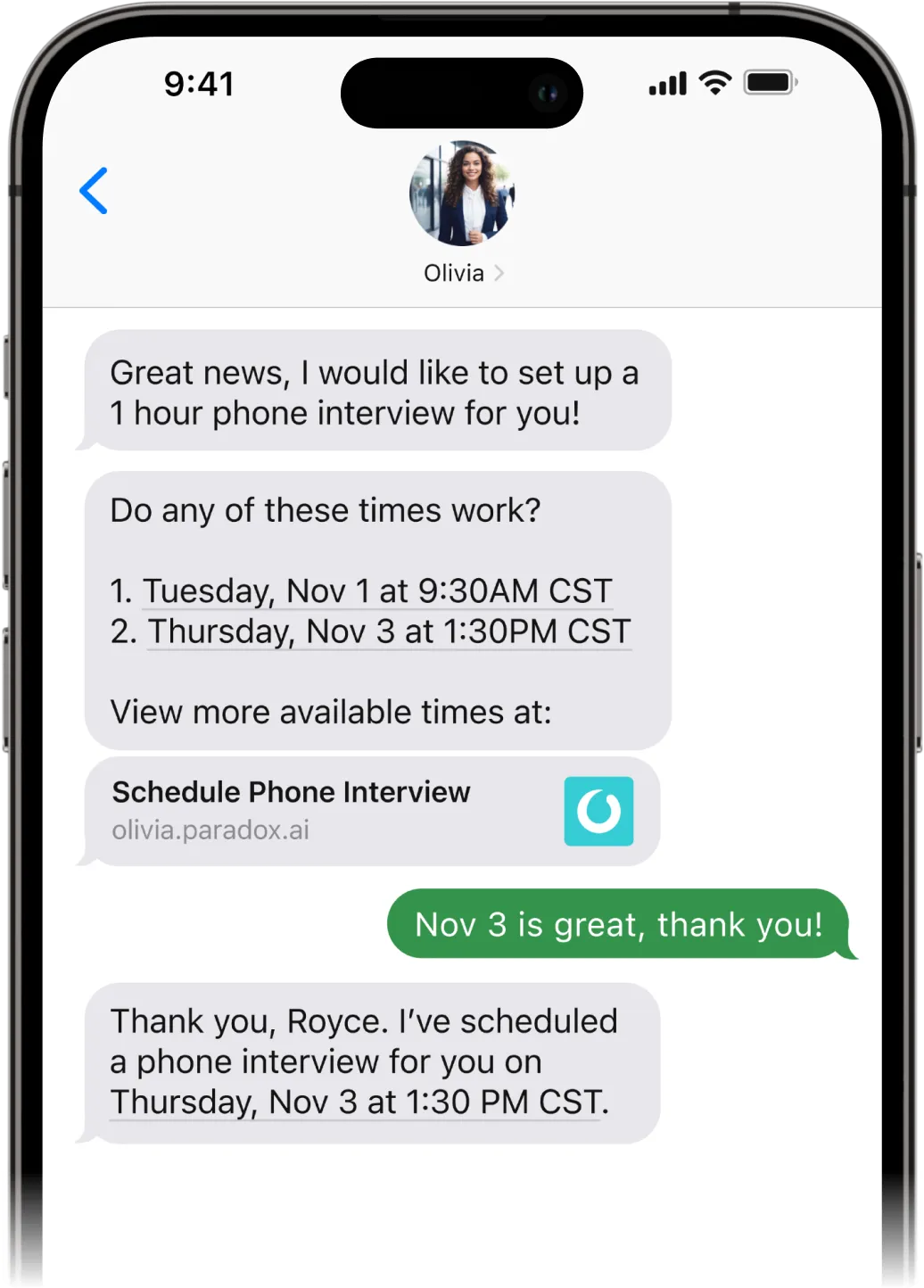
And functionally, Paradox creates a great candidate experience and a great hiring manager experience. I can't tell you how many times we’ve had a candidate that the recruiting team really liked and they wanted the hiring manager to talk to, but then the recruiter went out on vacation and something happened to the candidate on the day of their interview — something crazy, like their dog's car got a flat tire. So the candidate sends an email to the recruiter saying, “Hey, I'm not gonna be able to make this interview in two hours,” but the recruiter is on a beach somewhere. So the hiring manager is agitated because they feel like this otherwise great candidate stood them up. Now with Olivia, the candidate has the ability to say, “I'm not gonna be able to make it,” and they automatically get rescheduled. It just creates a much better experience for the hiring manager and it creates a better experience for the candidate. When you do those two things, you see success in hiring.
How do you decide what to automate in your hiring process? And how have candidates responded to that automation?
Last year we posted 750 professional roles, and of those, we got 95,000 distinct candidates. So people want to work at OneDigital, which is a really good testament to our culture. But now the problem is we have too many candidates to review. And so that's where we use AI: to quickly screen people to take that administrative work away from our team.

It just creates a much better experience for the hiring manager and it creates a better experience for the candidate. When you do those two things, you see success in hiring.

Honestly, I remember shortly after we went live, I had a candidate email our recruiter saying, “You're the first company I've ever applied to that uses a virtual recruiting assistant. This is incredible. The process was super smooth.” And that’s great because at the end of the day, that’s what we're trying to do: create a seamless experience for candidates.
What about internally — how did you convince your team and leadership to change your tech stack?
People aren't reluctant to change. They’re reluctant to uncertainty. That doesn’t mean you can’t go into change with some degree of uncertainty. But you need to be willing to explain why the change is happening, what the purpose is, and what benefits you're going to gain. I find that your business leaders tend to follow you more if they trust that you have a plan and you're not flying by the seat of your pants. That’s how you get buy-in.
Of course, people are going to be committed to processes that they've already spent money on, and that’s fine. But it's a sunk cost, and you can’t throw more good money after bad. And you have to create an environment where people understand that. Everybody makes the best decision with the information they have when they make that decision. But you get new information all the time — the AI evolution is happening daily. And that continuously evolves the way that we can do things. If you asked me a year ago what I thought AI was going to do for the world, I would have said it would make chatbots suck less. But now when you see how agentic AI is automating tasks with purpose, that’s new information we didn't have 18 months ago. So changes or pivots aren’t an indictment on anyone necessarily, but that doesn’t mean it’s not good for the business to change. More is lost from indecision than from making the wrong decision.
It seems like OneDigital is a pretty forward thinking company. How else are you using AI?
We're very fortunate that we have really leaned heavily into the AI space. At OneDigital, we’ve built 11 internal AI co-workers that are running and serve various purposes to support the business. For example, we have Ben, our benefits guide, who you can go to and say, “Hey, I’m going to go talk to Paradox about our renewal — give me an update on the company.” And then Ben will give you five things that happened recently and five things to stay clear of in your discussion. So stuff like that has been helpful. Our TA tech stack has really given us a competitive advantage. And Paradox is a critical part of that.