




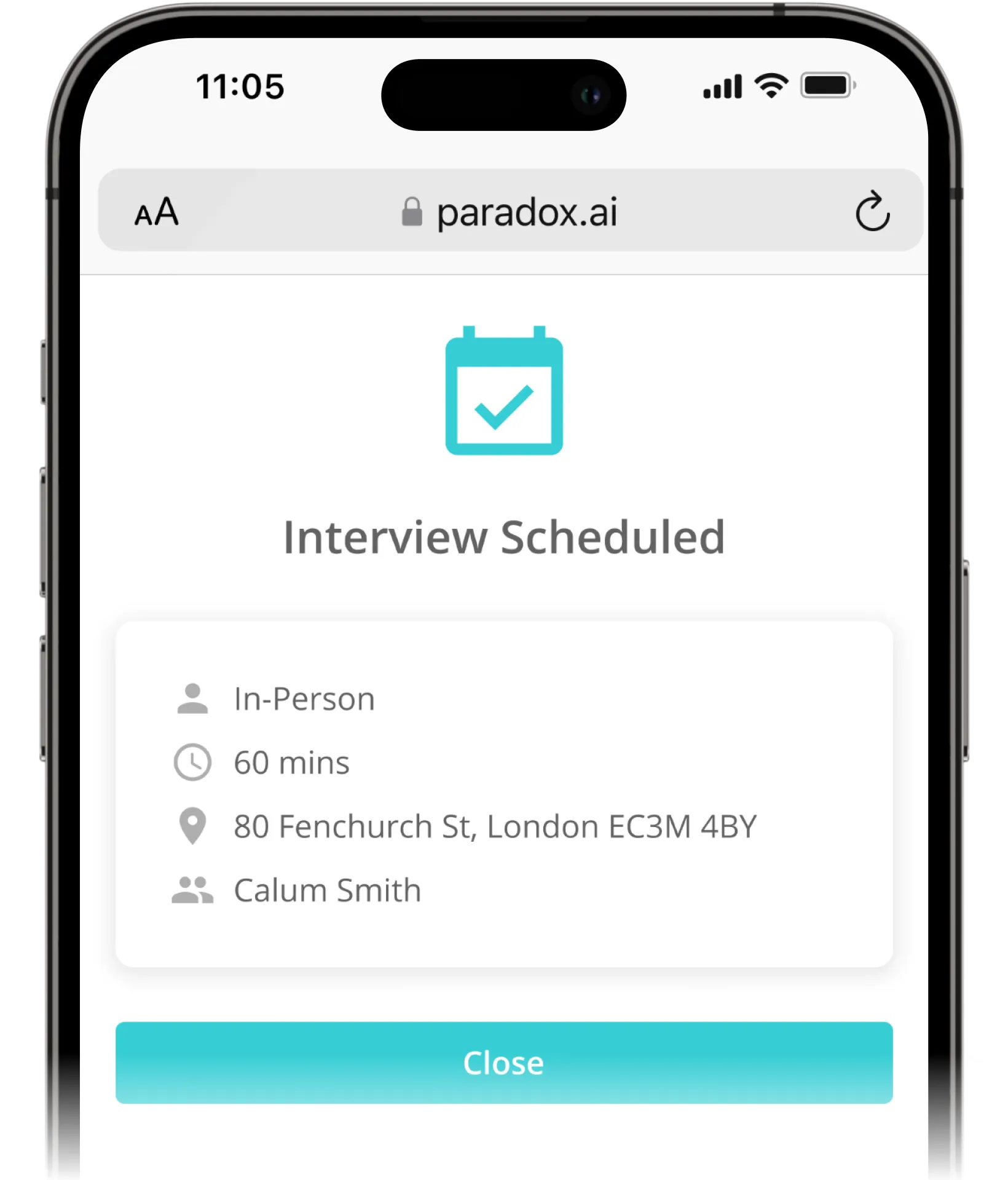
When Royal London, the U.K.’s largest mutual insurer, moved their recruiting in-house, they sought a way to speed up their hiring without adding headcount to their recruitment team. Enter AI. With a robust interview scheduling solution, powered by an AI assistant named Peli, Royal London brought their time-to-schedule interviews down from three days to just 37 minutes.
We recently sat down with their Group Head of Recruitment Richard Matthews to chat about the move to internal recruiting, and how the right tech made a big transition possible.
What has drawn you to working in the financial services industry? What sets it apart from other industries in terms of impact?
Richard Matthews: For me, the financial services industry is often at the forefront of many technology changes. Customers want to engage in innovative, modern ways, whether that’s with pension products, with asset managers, or even retail touchpoints. Everyone has a bank account, so everyone has a level of understanding about using financial services. And it’s become even more important with cost of living crises around the globe and the global economy. Geopolitically, the industry touches all of us locally every single day. I love the impact it has.

And as a mutual, the impact is multiplied for Royal London. We’re owned by our members. So what does that drive? It drives longer term thinking. It drives a focus around product development. There’s a legacy here that we feel responsible for. It’s hard to describe — you need to be living and breathing it daily to really understand what it is to work for an organization that is member-owned. You can actually see and feel a lot of the benefits and profit share from our products. The mutuality of the organization, I think, is very much touching society and where society’s gone in the last decade.
Talk to me about how Royal London recruits. Why did you decide to switch from outsourced recruiting to an in-house team?
RM: We had outsourced our recruitment for the last 12 to 15 years, but a year ago we came across a decision about whether we should continue to outsource with our current RPO partner, change to a different partner, or look to build out that capability in-house. Ultimately we made the decision to in-source recruitment, and funny enough that decision wasn’t driven by cost. So many other organizations will make that decision purely on brass tax in terms of money. But from our perspective, it was much more around the candidate and hiring manager experience. I touched on the mutuality of the organization where our members are partnering with us, so we wanted to bring them a better experience. After we brought recruitment in-house we saw the number of hires, which had been fairly consistent over the last five years, dramatically rise to the point that we’re hiring more than ever. Which has focused us. How do we evolve? How do we bring innovation? We needed to make sure that we can deliver the flexibility that we got with our outsource partners now through an in-house partnership and team.
You touched on needing to evolve to keep up with your candidates. Can you go a bit deeper into how Royal London is leveraging AI to stay relevant?
RM: We’ve been around for nearly 200 years now, and we want to be here for another 200, 300 years. Evolution is key to that goal, and leveraging AI is key to evolving. AI is here whether we like it or not, so as long as we put the correct guardrails around it in terms of development across the organization, we’ll be in a better spot. That thought process is very much driven from our own CEO. He knows that AI and technology skills are evolving.

AI is here whether we like it or not, so as long as we put the correct guardrails around it in terms of development across the organization, we’ll be in a better spot.

Our team was one of the first teams across the entire organization to use AI. So there’s a lot of organizational interest: How's it working? How's it feeling? What does it feel like for candidates? And from a sentiment perspective, it’s going very well. For the service as a whole, we're tracking an NPS score of 72, and the industry standard across financial services in the UK is 44. So very quickly you can see the impact that AI is having.
Tell me more about how AI affects the candidate experience. You mentioned the NPS score, but what is specifically going into that bump?
RM: Right now we have Peli, our AI assistant, automating our interview scheduling. We just went live in April, so we’re still working through that kind of full ROI that will come in next year. But anecdotally, we’re just faster. We're already seeing some of the interviews which used to get scheduled in two or three days now be scheduled in 1 ½ minutes. And we’re also doing it in a way that candidates want to engage: over text. So our process feels much slicker, much more positive, and much more forward thinking than our competitors. And getting to top talent first is really, really important. Even more so when it’s your specialist roles — your key people that you’re up against four competitors to hire. Getting to them quicker, getting them scheduled quicker and through the process quicker has never been more important than it is today.
What other results are you seeing since you’ve started using AI to help schedule interviews?
RM: We have newfound flexibility from our own team. As soon as we launched Peli, we were able to pivot some of our team’s operational workload into different areas, enabling us to think longer term. And because we’re getting people into and through the process quicker, we can make more informed decisions quicker about the demand out there. We can decide if we need to go after X, Y, or Z types of talent or if we’re doing absolutely the right thing. It’s all because we’re much faster on the front end.
And our team has seen the benefit of automation too. We’ve had some bank holidays in the UK and our team looked ahead on their calendars and blocked off their interview availability so they’re not inundated after coming back. And so everything is getting mapped out. And that enables us to really help with resource planning and demand planning across the team. And when anyone is becoming particularly stretched, it gives us that flexibility to move around. So there’s a time savings piece, an experience piece, and a cost piece. We're doing more for less.