





When Elevo Learning began their search for new hiring tech, they had two goals: make applying for a job easier, and reduce their short-term turnover. Well, the education company solved their two problems with one new ATS — one that automates administrative work and lets recruiters spend meaningful time with candidates.
We recently sat down with Elevo’s Director of Talent Communication and Platforms Megan Schuck to chat about the importance of hiring quality educational candidates, and how Elevo leverages AI to do it right.
Talk to me about hiring for education. Why is it so important to get it right?
Megan Schuck: It’s so important. This will sound very cliché, but education really is shaping the future of our country, our world. I’ve been working in education for two decades now, but it didn’t really click with me like it does now until I became a mother. You know, as a mom to three young children, I can kind of see how my career and all the work that I've done in education creates an impact from elementary school all the way up through higher education and beyond.
Take my six-year-old son. His teachers, along with his after-school teachers, are with him more waking hours than myself or my husband. So those teachers have to be an extension of the values I’m teaching in my own home. I’m teaching him to be a kind, considerate, thoughtful human being — I want them to do the same. So I have to care about who is teaching him and the environment that he’s being taught in. Kids are so impressionable at a young age, all the way up to adolescence and even in higher education. We have to get it right.
Can you explain the difficulties in finding the right people for your roles? Why is it hard to get ideal candidates?
MS: Right, so at Elevo we need to hire between 2,500 and 3,500 coaches every year in the state of California. Those coaches are teachers, by the way — we call them coaches. And we need to make sure that every single one of them is a quality hire, and not just someone who wants a job, a paycheck. We want someone that believes in the mission, that wants to be there for the children, and that believes in the curriculum we’re teaching in. We focus a lot on social and emotional learning, primarily right now through sports and movement, and so it’s really important to have coaches that want to be here, and want to stay.
It’s not for everyone. I personally work with a lot of college students and they are mission-driven. They want to work for a company that they believe in. But just because you believe in the mission doesn't mean that you're going to be right for every role. If you’re teaching a class of 20+ students, that's a really challenging position. And if you don't have the right expectations going into it, it could be very disappointing. You're not going to want to do it for a long time.

We want someone that believes in the mission, that wants to be there for the children, and that believes in the curriculum we’re teaching in.

And having a familiar face is very important to an eight-year-old. We don't want to hire someone, train them, get them into their role, and have them just have it not be what they expected. So it really is important in the beginning of the hiring process that expectations are laid out, that we're attracting the right type of applicant.
So how are you setting those expectations? What are you doing to make sure that you’re spending time on the right candidates?
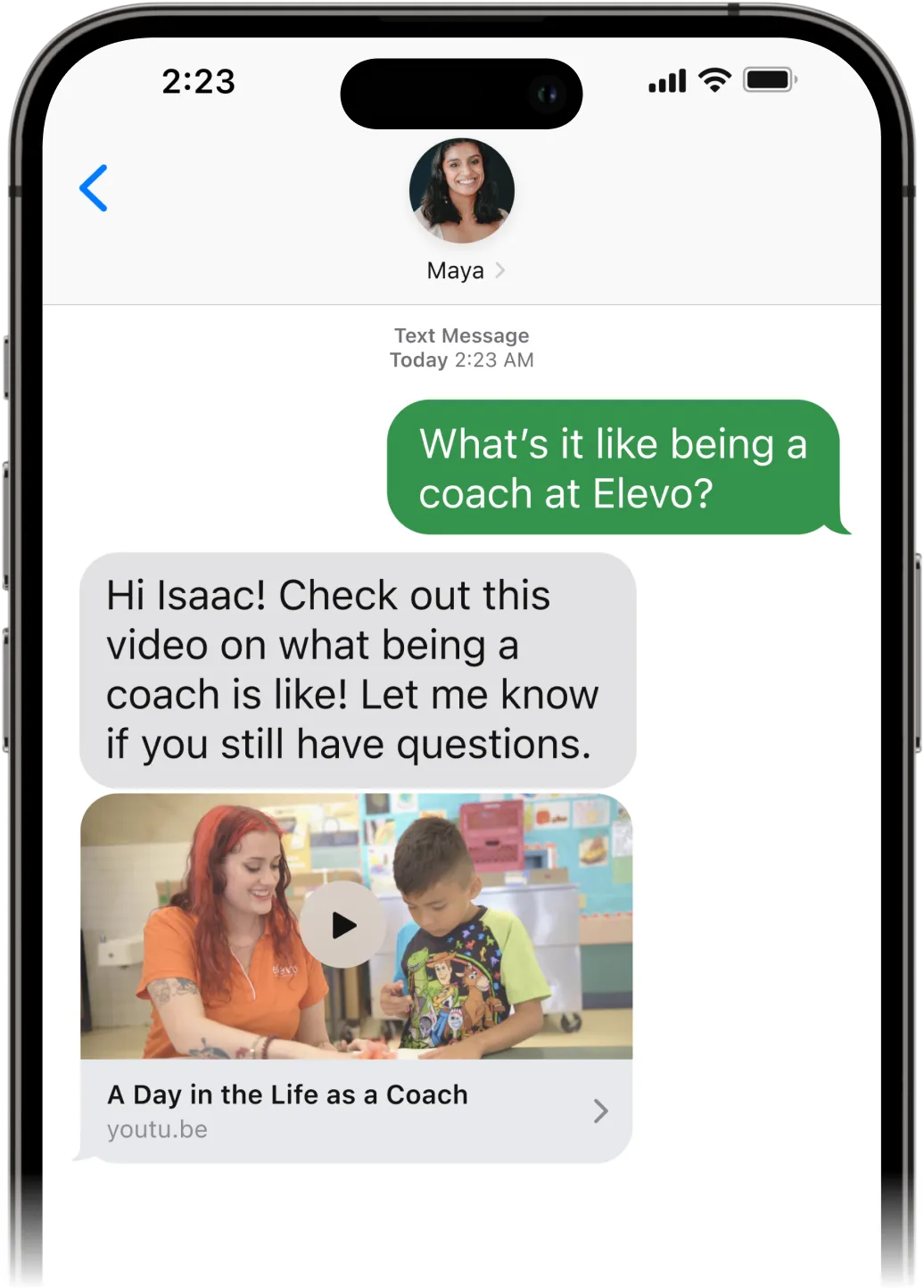
MS: We’re really working to ensure that we’re painting the right picture at the beginning of the process, right? Setting the correct expectations of what it’s like to be a teacher in front of X number of students. A lot of the time, that’s showcasing videos in our first interaction — we’re leveraging Paradox to do that — which showcase a day in the life of one of our coaches. Because if someone watches that and thinks it’s not for them, we’d rather have them opt out than apply. That way our hiring teams can spend time with the people that are going to be better fits — people who we will be able to actually retain.
You mentioned Paradox; why does conversational AI connect with the candidates you’re looking to hire?
MS: Conversational application processes really click with the population that we're focused on. Again, for my role with university students, I’m working with people who are used to always having their phone, texting, and applying quickly. When I started this journey, I wondered if students even stored resumes on their phone? I mean, I don’t. But they do.
And the questions we’re asking them to answer, I think, are really tailored towards that audience too. We aren’t asking them to write an entire essay on why they want to be a coach. We have quick questions about things that you can easily text: Do you want to work with kids? Are you comfortable working with 15 to 20 students at one time? Prior to Paradox, we didn’t have that ease and accessibility. So just having the application process be quick and easy and available whenever they want is huge.
Absolutely. Do you have an “aha” moment from when you first went live? How did you know this was gonna work?
MS: Yes! So prior to Paradox, scheduling was a big challenge. We were doing a lot of cold calling and leaving a lot of voicemails, and by the time we got the candidate scheduled two weeks had passed already. I mean, we really were spending hours calling people, leaving messages, going through resumes. And now we’re automating that process. Our AI assistant is linked to all of our recruiters’ calendars and provides applicants a couple of different options so they can pick whichever time works best for them.
We launched on a Wednesday — by Friday our recruiters had their calendars filled with 15 to 20 interviews. Seriously, from Wednesday to Friday it was done just like that. So it was incredibly exciting just seeing that within three days the metrics that happened: the improvement of the time it took to schedule interviews and the time to fill out an application. We went into the weekend thinking, ‘Okay, we made the right choice. This is amazing.’